



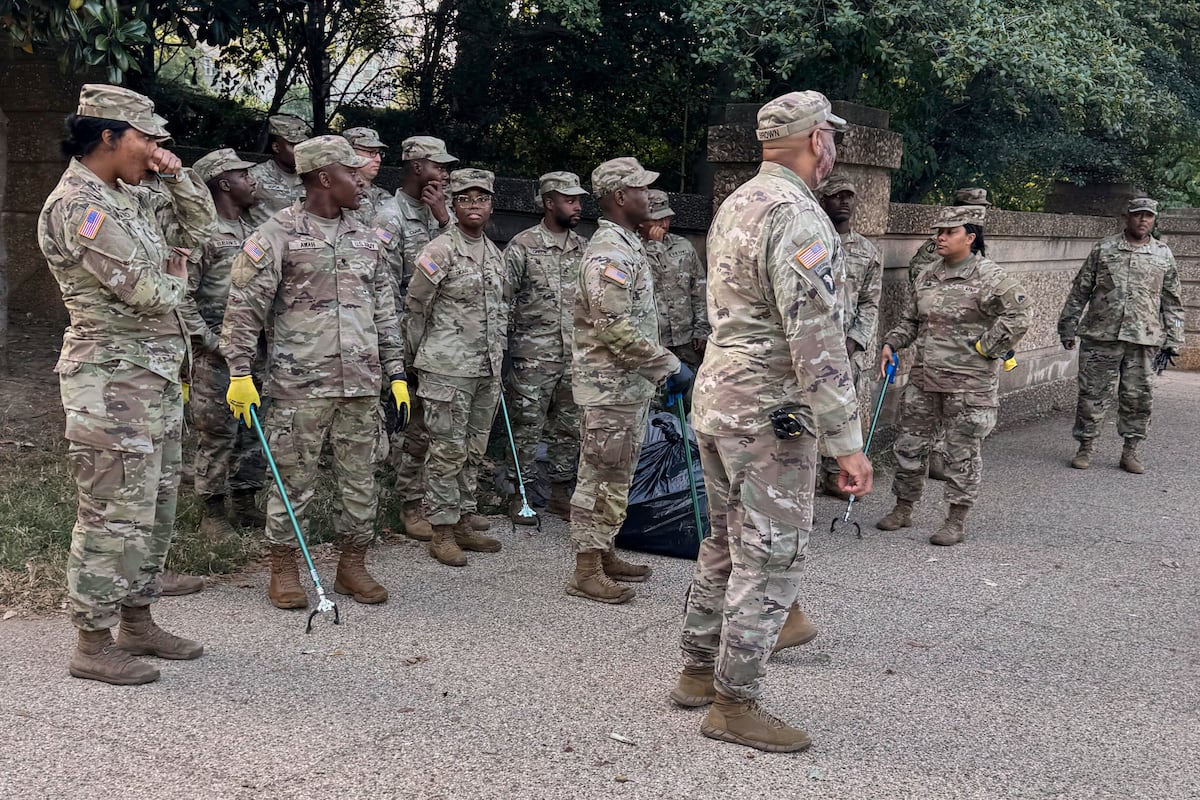

Since Aug. 11, 2025, nearly 9,700 National Guard troops from across the nation have been shipped into Washington, D.C., and put up in hotels in service of the “Make DC Safe and Beautiful” mission ordered by President Donald Trump.
As the mission approaches the conclusion of its first year — with at least two more to go, unless the president says otherwise — its measure of success depends on whom you ask. In a round-table discussion with reporters Monday, Brig. Gen. Leland Blanchard, the D.C. National Guard’s interim commanding general, suggested the impact of the Guard’s presence was as much about an increased feeling of safety as it was about the number of interventions.
Those numbers, in the context of the size of the Guard deployment, are modest. Blanchard said Guardsmen had provided 788 medical assists, “ranging from administering CPR to applying tourniquets for gunshot victims;” reunited 43 lost children, intervened in 262 fights to prevent further escalation; and administered the overdose reversal drug Narcan to 325 people. Guard members supported law enforcement 479 times, he said, or a little more than once per day over the course of a year-long deployment.
“Those are not simply numbers. Those are not just data points,” Blanchard said. “Each of those represents fathers, mothers, children, people who have received emergency care, been returned to parents, and families, had their lives saved from opioid overdoses, or were involved in violent situations brought under control before further harm was done.”
He added that a Guard team on a “ride the rail” mission on the D.C. Metro had stopped a sexual assault in progress and recently intervened to stop a knife-wielding would-be assailant.
Blanchard said the Guard members’ presence was having its own impact. Guard troops recently began patrolling Starburst Plaza, a well-known hub for drug activity in northeast D.C. During a visit to the area Aug. 1, he said, he observed an Air National Guard member administering Narcan and “saving a life on the scene.”
“A few minutes later, a young teenager rode by on his scooter, stopped, and said, ‘I’ve never seen this place so clean,’” Blanchard said.
It remains unclear, however, how lasting those changes will be – or whether the impact justifies the missions’s cost. The Congressional Budget Office has estimated the cost of the D.C. deployment to be $55 million per month. Based on the Guard’s reported Narcan administrations, that amounts to more than $2 million in costs for every overdose reversal. A new estimate provided this week to the office of Sen. Elizabeth Warren, D-Mass., estimates the mission will cost another $1.4 billion through its expected conclusion in January 2029, when Trump is slated to leave office.
Plans to move the Guard members from hotels into apartments via a $292 million contract awarded in July to corporate lodging company Placemakr are set to save the Guard about $90 million, Blanchard said, adding that they’ll also allow troops to be “closer and more responsive” to their mission areas.
There are currently just over 4,600 Guard troops in D.C., Blanchard said, and that number is expected to decrease somewhat as summer and 250th anniversary events come to a close.
A May study from the nonpartisan think tank Niskanen Center found that the Guard deployment correlated with a sharp decrease in specific kinds of crime, including vehicle theft and other opportunistic property crime in high-visibility spaces. But robberies and other violent crime trends stayed constant, it showed.
“The implication is sharp,” the study found. “The National Guard deployment appears to have deterred opportunistic property offending, exactly the category of crime most sensitive to visible, high-presence enforcement on the street. Violent crime was unmoved.”
Asked about recent reports, Blanchard said the report showed “there’s a positive impact where the Guard is on crime,” though the study authors “disagree with some of the locations” where the Guard has spent its time.
“As we move forward, what we’ll do is bring the same impact that we’re seeing,” he said, citing the recent move into Starburst Plaza.
“We have definitely seen a significant impact there,” Blanchard added. “I think we’re going to continue to bring that impact across the city as we expand.”
The Guard is now moving into its next phase of the D.C. mission, Blanchard said. While he provided few details about what the phase would entail, he mentioned specific higher-crime metro areas, including D.C.’s Ward 8 and Trinidad neighborhood.
“We’ll still be downtown, and we’ll still be in the neighborhoods that we’re in right now,” he said. “We’ll just shift some of those resources, and again, working in coordination with federal law enforcement and the Metropolitan Police Department, reallocate and repurpose some of those personnel.”
Read the full article here
